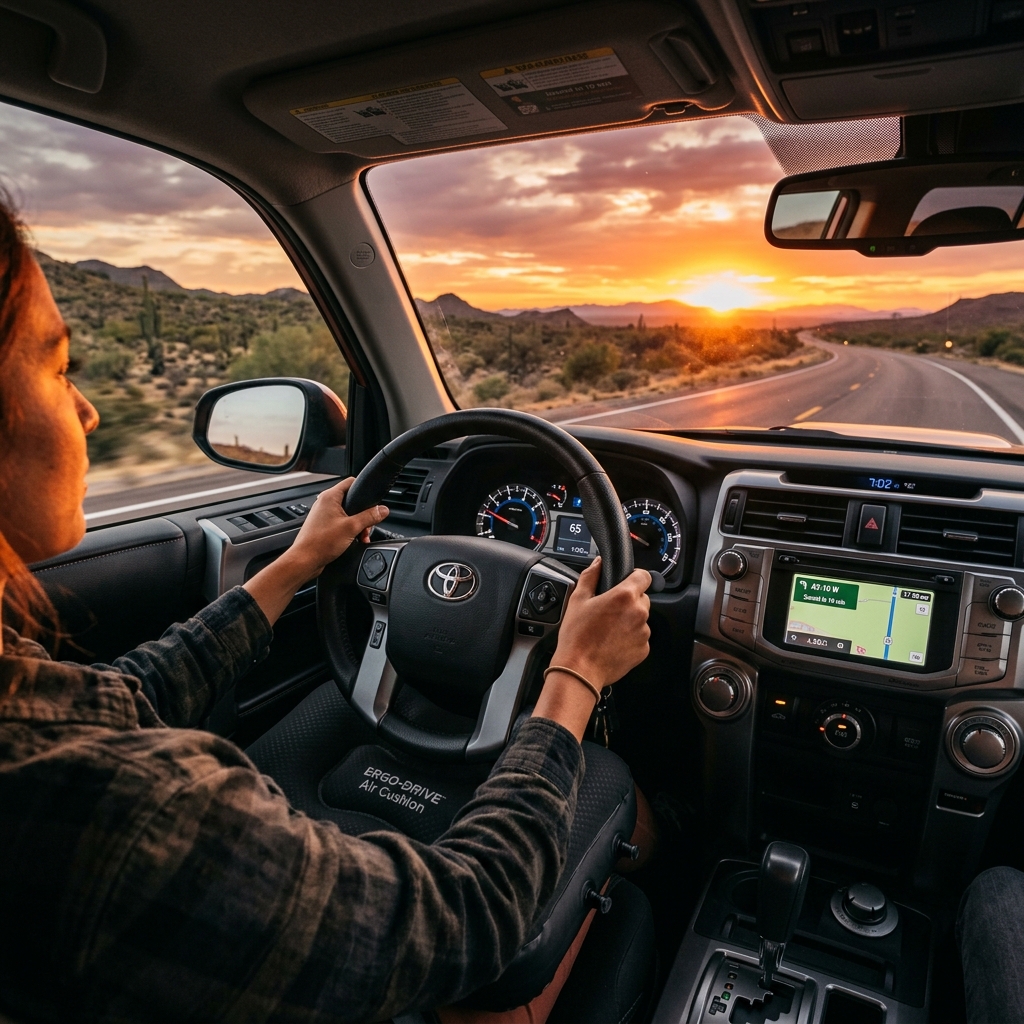
While flying poses its own challenges, driving cross-country presents a unique threat to the human spine. When you drive, your legs are extended to operate the pedals, which mechanically tilts your pelvis backward and flattens out your natural lumbar curve. Add in the high-frequency vibration from the road, and you have a perfect storm for disc herniation and severe tailbone bruising.
1. Ergonomic Automotive Seating Pads
The vast majority of car seats bucket downwards towards the backrest, forcing your knees higher than your hips. This “C-shape” slumping destroys the L4-L5 vertebrae.
If you are suffering from sciatica while driving, the immediate, low-cost fix is throwing a portable air cushion right onto your driver’s seat. A high-quality cushion will elevate your pelvic floor, bringing your hips level with or slightly above your knees, restoring your body’s natural mechanical leverage for long hours behind the wheel.
2. Polarized Driving Sunglasses
Eye strain leads directly to neck strain. When you squint against road glare, you unconsciously crane your neck forward closer to the steering wheel, inducing “Forward Head Posture.”
- Opt for polarized lenses with a brownish tint for maximum contrast definition.
3. Hydration & The Rule of Rest Stops
Do not attempt “Ironman” driving stints of 6 hours straight.
- You must stop your vehicle every 2 hours.
- Get out, do 10 bodyweight squats, reach for the sky, and stretch your hip flexors against the bumper.
- Drink plenty of water; the inconvenience of having to stop for bathroom breaks is actually a biomechanical blessing in disguise. It forces you to move, re-lubricating the spinal discs with vital synovial fluid.
4. Steering Wheel Positioning
Your arms shouldn’t be locked straight out.
- Adjust your steering column so your wrists can rest comfortably on the top of the wheel while your shoulder blades remain firmly planted against the backrest.
- Maintaining a slight bend in your elbows prevents tension shocks from translating up your arms and into your neck and trapezius muscles.